Cat Food Calculator
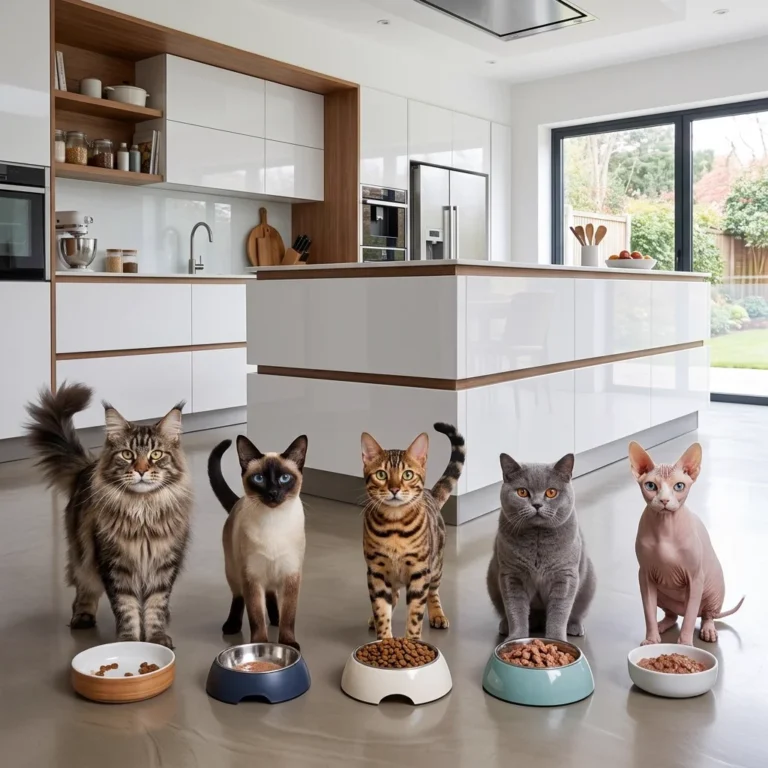
Cat Food Calculator
This tool gives general guidance only and is not a substitute for professional veterinary advice.
How many calories does a cat need per day?
Many indoor, neutered adult cats need about 1.0 to 1.2 times their resting energy requirement: roughly 150–200 kcal a day at 8 lb, 180–250 kcal at 10 lb and 230–320 kcal for a large 12–14 lb cat. The calculator uses 1.0 for an indoor, mostly calm cat and 1.2 for a playful cat or one with outdoor access.
| Cat | Daily calories (approx.) |
|---|---|
| 8 lb (3.6 kg) indoor adult, neutered | 150–200 kcal |
| 10 lb (4.5 kg) indoor adult, neutered | 180–250 kcal |
| 12–14 lb (5.4–6.4 kg) large-frame adult | 230–320 kcal |
| Kitten | about 2.5 times resting energy, recalculated as it grows |
Treat these as starting points. The real test is the rib check two to three weeks later: ribs easy to feel under a thin cover, a visible waist from above. Our guide to how much to feed your cat covers body condition and meal feeding in detail.
How this calculator works
The calculator uses the standard veterinary energy formula: it works out your cat's resting energy requirement (RER), then multiplies it by a factor for life stage and lifestyle.
Step 1, resting energy: RER = 70 × (body weight in kg)^0.75.
Step 2, daily energy: RER × a factor from this table.
| Your cat | Factor used |
|---|---|
| Kitten under 12 months | 2.5 × RER |
| Neutered adult, indoor and calm | 1.0 × RER |
| Neutered adult, playful or outdoor access | 1.2 × RER |
| Intact adult | 1.2–1.4 × RER |
| Neutered senior (11 years and up) | 1.1–1.2 × RER |
Senior cats are never set below the adult number: many cats over about 10 to 12 need more calories, not fewer, because digestion becomes less efficient with age.
Step 3, portions: daily calories divided by your food's calorie density. US labels give kcal per can or per cup; European labels usually give energy per 100 g or per kg. The calculator accepts either.
How do I convert calories into cans, cups or grams?
Divide the daily calories by the calories in one can, one cup or 100 g of your food. A cat needing 220 kcal, eating a wet food with 90 kcal per can, needs about 2.4 cans a day; on a dry food with 400 kcal per cup, about half a cup.
Wet foods vary from about 70 to 200 kcal per can and dry foods from about 300 to more than 500 kcal per cup, so the label always beats a rule of thumb. If you feed both, split the calories between them, for example half from each, rather than adding the two amounts together. If your label gives energy only in kilojoules (kJ), divide by 4.184 to get kilocalories (kcal). Treats belong inside a 10% ceiling, taken out of the meal rather than added on top.
When should you not rely on a calculator?
Ask your vet instead of a calculator when your cat needs to lose weight, is losing weight without trying, is a kitten that has stopped gaining, or has a medical condition. Cats must never be crash-dieted: going without enough food can trigger hepatic lipidosis, a serious liver disease, so safe feline weight loss is slow and vet-supervised.
In cats, unexplained weight loss is often the bigger warning sign than gain, especially in older cats. See signs your cat needs a vet for what's urgent, and our kitten food and senior cat food guides for life-stage feeding.
Veterinary disclaimer: This calculator gives a general estimate for healthy cats, not a feeding prescription. Weight-loss programs, underweight cats, kittens falling behind, and cats with medical conditions need portions set with a licensed veterinarian.
Frequently asked questions
How much should I feed my cat per day?
A typical 10 lb indoor, neutered adult cat needs roughly 180–250 kcal a day. Divide your cat's number by the calories per can, cup or 100 g on your food's label to get the portion, then adjust by about 10% if your cat gains or loses weight.
How many cans of wet food should a cat eat a day?
It depends entirely on the can: wet foods range from about 70 to 200 kcal per can. A cat needing 220 kcal eats about 2.4 cans of a 90 kcal food, but just over one can of a 200 kcal food, so always check the label.
Do indoor cats need fewer calories?
Usually, yes. Many indoor, neutered cats need about 1.0 times their resting energy requirement, compared with the standard 1.2 for a neutered adult, because they move less. That's one reason so many indoor cats become overweight on bag-guide portions.
Can I put my overweight cat on a diet myself?
Not a fast one. Cutting a cat's food sharply can trigger hepatic lipidosis, a serious liver disease, so weight loss in cats should be slow and planned with your vet.
Pet Tools
Free tools for pet owners
Free calculators built for real decisions, not guesswork.
Cat Age Calculator
Find out how old your cat is in human years with the standard feline model.
Try toolPet Cost Calculator
See what a dog or cat will realistically cost you per year, in dollars or euros.
Try toolCat Breed Selector
Find which cat breeds suit your home, routine, and family.
Try toolDog Food Calculator
Work out the right daily food portion for your dog's weight and activity.
Try tool